

Whole Exome Sequencing
Exome-focused pipelines that concentrate sequencing depth on protein-coding regions — built for diagnostic yield and mutational analysis without the cost of a full genome.
TYPICAL CLIENT
A diagnostics lab that needs coding-region answers on a clinical budget
Usually a clinical genomics director or research PI running a rare disease diagnostic program or a tumor mutational-burden study, who needs deep, reliable coverage of coding regions without paying for whole-genome depth they won’t use.
Six concrete deliverables, not a slide deck.
This is exactly what transfers to you at the end of this Whole Exome Sequencing engagement.
Capture-kit aware pipeline
A pipeline configured to your specific exome capture kit, so target-region coverage is optimized, not generic.
Per-target coverage QC
Coverage reported down to the individual exon, so gaps in diagnostic-relevant regions are visible before sign-off.
Variant calling & clinical annotation
GATK-based calling with variants classified against ACMG/AMP criteria to support clinical interpretation.
Trio & family analysis module
Joint calling and inheritance-pattern filtering for proband-parent trios or larger family sets.
Mutational burden & hotspot reporting
For tumor exomes, a summary of mutational burden and known hotspot variants alongside the full callset.
Full documentation & handoff session
Written documentation plus a recorded walkthrough so your team can operate the pipeline independently.
What this service includes
Capture-aware target QC
Coverage and uniformity reported against your exact capture kit’s target BED file, not a generic exome definition.
Clinical-grade variant calling
GATK and DeepVariant calling tuned for diagnostic-grade sensitivity on coding regions.
ACMG/AMP classification support
Variants pre-classified against ACMG/AMP criteria to speed up clinical review, not replace it.
Trio & family inheritance analysis
De novo, recessive and compound-heterozygous filtering built into the standard workflow.
What this looks like in a real engagement
Three concrete examples of the kind of work this service covers.
Rare disease diagnostic exome
A proband exome analyzed against phenotype-driven gene panels to identify a likely causal variant.
Tumor exome for mutational burden
Tumor-normal exome pairs processed to report somatic mutations and overall tumor mutational burden.
Carrier screening exome panel
A cohort of exomes screened against a defined gene list for recessive carrier status.
Why exome depth beats genome breadth for a diagnostic question.
When the clinical question lives in a gene’s coding sequence, spending your sequencing budget on genome-wide breadth is often the wrong trade. Exome sequencing lets you go deeper on the regions that matter, catching low-frequency mosaic or somatic variants a shallower whole genome might miss.
We build exome pipelines around your specific capture kit and clinical question, so the coverage you pay for is coverage you can actually use in a diagnosis.
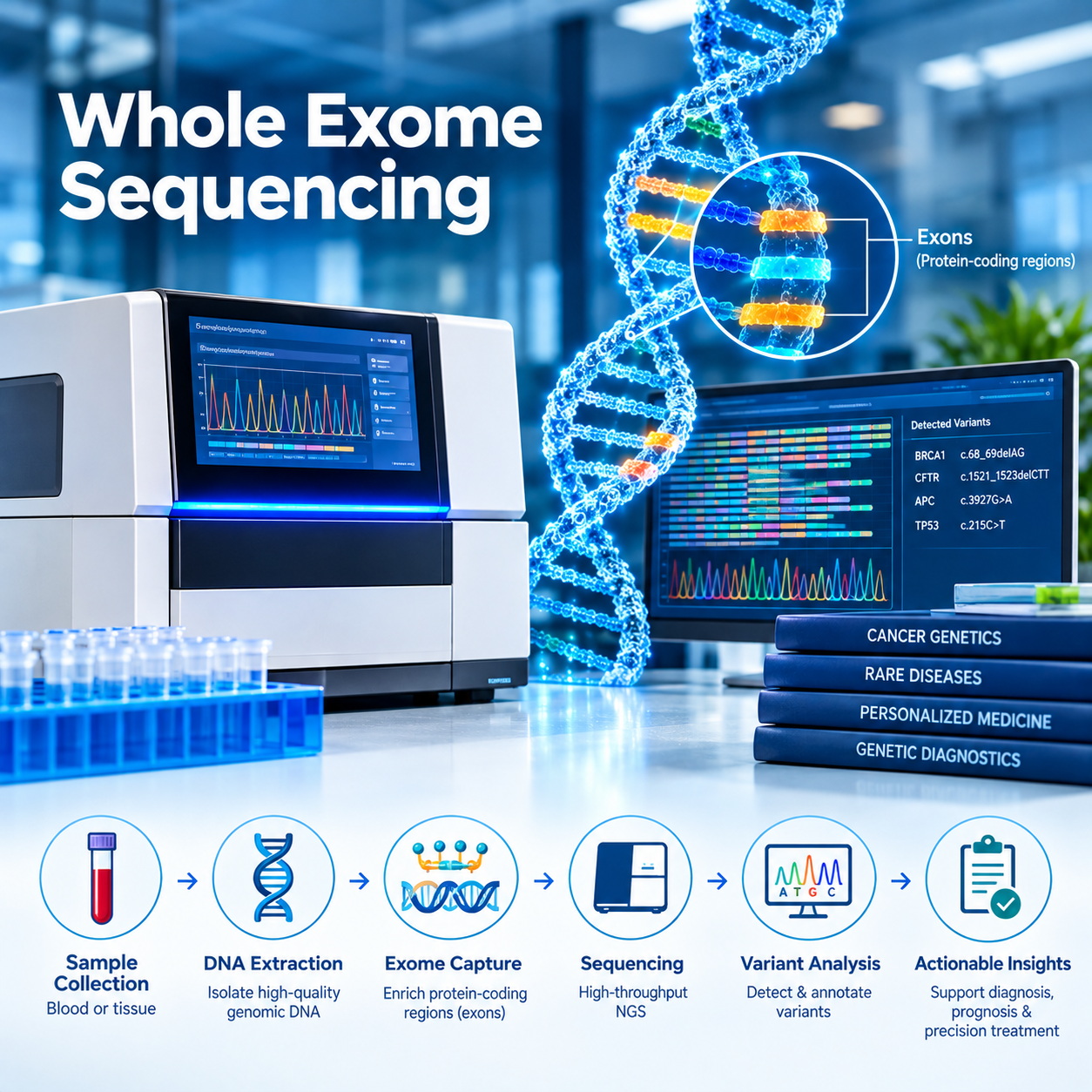
How an engagement runs
Four stages, from sample intake to delivery.
Sample & capture QC
Raw reads are checked against your capture kit’s target regions before alignment begins.
Alignment & variant calling
Reads are aligned to coding regions and variants called with diagnostic-grade sensitivity.
Annotation & classification
Variants are annotated and pre-classified against ACMG/AMP criteria for clinical review.
Report & hand off
A final report and full documentation are delivered alongside a walkthrough session.
What we build it with
An exome is only as good as the capture kit it was designed around — we build the pipeline to match, not the other way round.
Before you reach out
Typically 100× mean on-target coverage for diagnostic work, with higher depth available for mosaic or low-frequency variant detection.
Yes — the pipeline is configured against your kit’s target BED file, whichever vendor you use.
We provide ACMG/AMP-informed pre-classification to support your clinical reviewer, not a final sign-off — that stays with your certified team.
Explore related work
Whole Genome Sequencing
Step up to full-genome coverage when the causal variant could be structural or non-coding.
View AMPAmplicon Sequencing
A narrower, deeper alternative when you only need a defined gene panel.
View BIOBioinformatics Pipeline overview
See how whole exome sequencing fits into the full Bioinformatics Pipeline service.
ViewHave exomes waiting on a diagnostic answer?
Send us your capture kit and clinical question — we’ll tell you honestly what the data can and can’t support before you commit budget.