

Plasmid Sequencing
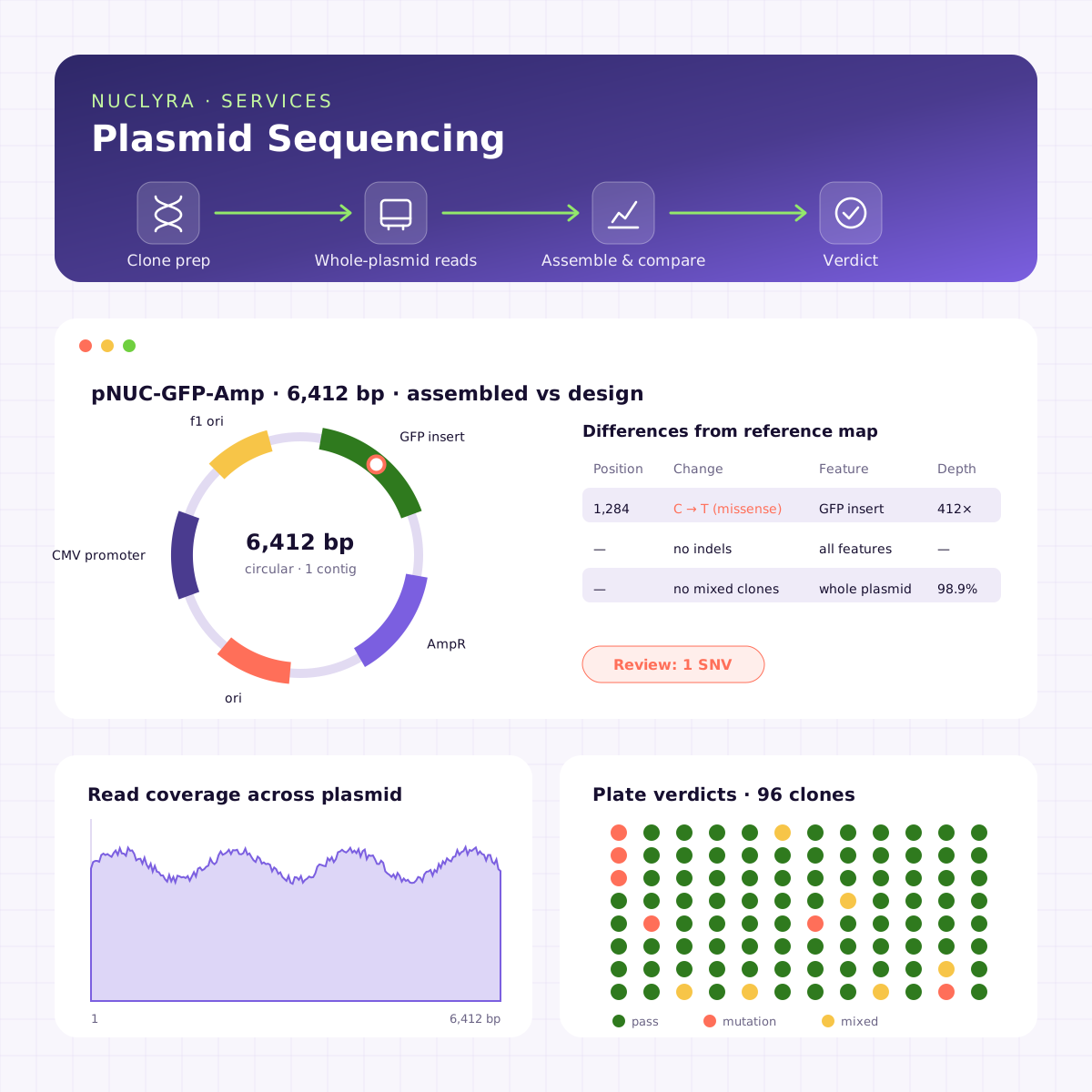
Whole-plasmid sequencing pipelines that assemble every construct end to end, compare it base by base against the intended design, and flag mutations, rearrangements or mixed clones before they cost you an experiment.
TYPICAL CLIENT
A team that can’t afford to build on a construct that isn’t what it says it is
Usually a synthetic biology lab, cloning or sequencing core, or a viral-vector and biologics team processing dozens to thousands of plasmids, who needs every clone verified across its full length — not just the insert a Sanger primer happened to cover — with results in a format that drops straight into their LIMS or batch records.
Six concrete deliverables, not a slide deck.
This is exactly what transfers to you at the end of this Plasmid Sequencing engagement.
De novo circular assemblies
Each plasmid assembled end to end from ONT or Illumina reads, circularized and rotated to a consistent origin.
Reference comparison against your map
Every assembly aligned to its expected GenBank or SnapGene map, with SNVs, indels and rearrangements listed by position.
Automated feature annotation
Origins, resistance markers, promoters, tags and inserts annotated so the delivered map is readable at a glance.
Mixed-population & contamination checks
Detection of mixed clones, size variants, multimers and host or cross-sample contamination in each well.
Batch pass/fail QC report
A per-sample verdict with coverage, consensus accuracy and the exact reason any construct failed.
Full documentation & handoff session
Written documentation plus a recorded walkthrough so your team can operate the pipeline independently.
What this service includes
Circular assembly
Read QC, de novo assembly, polishing and circularization for every construct.
Design verification
Base-level comparison of each assembly against the intended plasmid map.
Feature annotation
Standard plasmid features and inserts annotated on the delivered sequence.
Batch QC & reporting
Pass/fail calls, coverage and mixed-clone flags across whole plates.
What this looks like in a real engagement
Three concrete examples of the kind of work this service covers.
High-throughput clone verification
Plates of 96 or 384 clones verified overnight, with a pass/fail call and a corrected map for every well.
AAV and viral-vector plasmid QC
Transfer, packaging and helper plasmids checked across repetitive ITR and LTR regions that short reads struggle to span.
Library and variant pool checks
Mutagenesis or variant libraries sequenced to confirm diversity, coverage and the absence of unintended changes.
Why verifying only the insert leaves most of the plasmid unchecked.
A construct can carry a frameshift in a selection marker, a recombined repeat, a deleted promoter or a second plasmid in the same prep — and still give a clean Sanger trace across the insert. Those problems surface weeks later as failed expression, unstable cell lines or a vector batch that won’t release.
We build plasmid pipelines that assemble and check the whole molecule against its design, flag mixed populations explicitly, and report every difference by position, so the decision to use or reject a clone is made on complete evidence.
How an engagement runs
Four stages, from sample intake to delivery.
Reads & reference maps
Raw reads are paired with each sample’s expected plasmid map and run through read-level QC.
Assemble & polish
Each plasmid is assembled de novo, polished and circularized to a consistent start position.
Compare & annotate
Assemblies are compared to the design, annotated and screened for mixed populations.
Report & hand off
Per-sample verdicts and corrected maps are delivered, documented and handed over.
What we build it with
A clean trace across the insert is not the same as a verified plasmid.
Before you reach out
It helps — with a GenBank or SnapGene map we report every difference from the design. Without one, we still deliver a de novo assembly and annotated map you can review.
Oxford Nanopore whole-plasmid reads are the most common input, and we also support Illumina and PacBio data, including hybrid assemblies where both are available.
Yes. Long reads span ITRs, LTRs and other repeats that break short-read assemblies, and we flag any region where coverage or consensus confidence is too low to call.
Explore related work
Long-Read Sequencing (ONT / PacBio)
The long-read methods that make end-to-end plasmid assembly possible.
View AMPAmplicon Sequencing
Targeted sequencing for checking specific regions across many samples.
View WEBScientific Web Applications
Connect verification results to your LIMS, ordering or batch-record systems.
ViewHave plasmids waiting on full-length verification?
Tell us your sequencing platform, construct sizes and weekly volume — we’ll scope a verification pipeline that fits your throughput.