

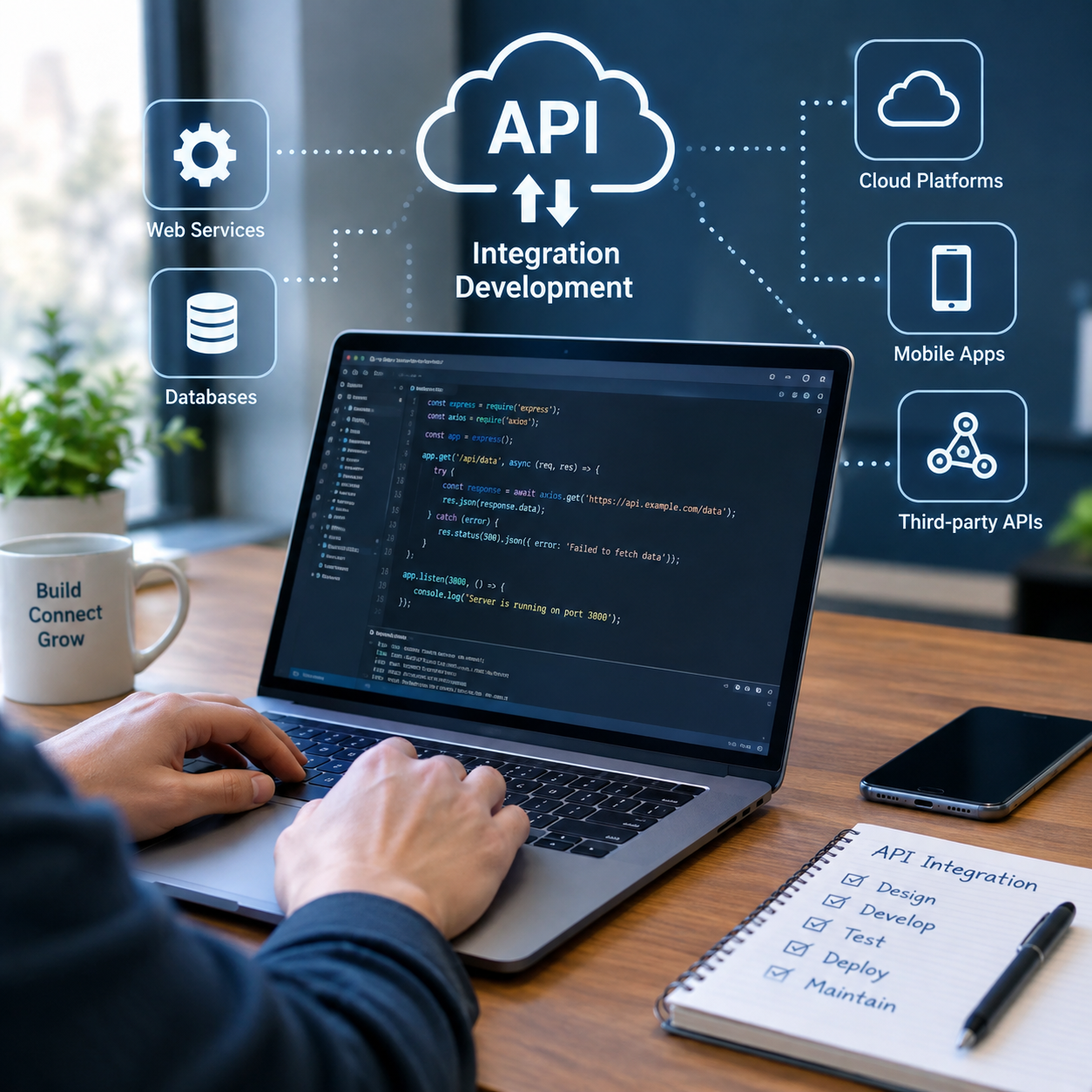
API & Integration Development
Clean integration layers across lab instruments, ELNs, LIMS and existing databases — so your systems actually talk to each other, instead of relying on a script someone quietly maintains by hand.
TYPICAL CLIENT
A platform lead maintaining integrations held together by one-off scripts
Usually a Platform Lead or Head of Engineering whose lab or company runs several disconnected systems — instruments, LIMS, ELN, CRM — connected today by scripts nobody fully trusts, and no monitoring for when they quietly break.
Six concrete deliverables, not a slide deck.
This is exactly what transfers to you at the end of this engagement.
Integration architecture & data flow documentation
A clear map of every system involved and exactly how data moves between them.
Built & deployed API layer
A maintained integration layer running in production, not a script on someone’s laptop.
Authentication & access control per integration point
Each connection secured and scoped to only the access it actually needs.
Error handling & monitoring for data sync
Alerts that fire when a sync fails, instead of someone noticing the data looks wrong a week later.
API documentation
Documentation for internal teams and external partners who need to integrate against the system.
Source code & infrastructure-as-code
Full repository access plus infrastructure configs, transferred outright.
What this service includes
API design & architecture
Integration points designed as a coherent layer, not a growing pile of individual point-to-point scripts.
Instrument & LIMS/ELN integration
Direct connections to lab instruments, LIMS and ELN systems, built around their actual data formats and quirks.
Authentication & access control
Each integration point secured individually, so a compromised credential doesn’t expose every connected system.
Monitoring & error handling
Sync failures and format changes surfaced immediately, instead of discovered downstream.
What this looks like in a real engagement
Three concrete examples of the kind of work this service covers.
Instrument-to-LIMS integration
A direct integration layer between lab instruments and a LIMS, removing a manual export-and-upload step from the daily workflow.
Partner-facing API for external collaborators
A secured API letting partner labs submit and retrieve data programmatically, replacing email attachments and manual uploads.
Legacy database sync to a new warehouse
A monitored sync layer keeping a legacy database and a new cloud warehouse consistent, without a nightly manual export.
Why duct-taped integration scripts fail quietly, not loudly.
A script that works today usually keeps working right up until a vendor changes an export format, a field gets renamed, or a rate limit gets hit — and there’s no monitoring to catch it before someone notices the numbers look wrong.
We build integrations as a maintained layer with real error handling and alerting, so a broken sync gets flagged the moment it happens, not discovered downstream in a report.
How an engagement runs
Four stages, from initial scope to delivery.
Map systems & data flow
We identify every system involved and exactly how data currently moves, or fails to, between them.
Design the API layer
An integration architecture is proposed that replaces one-off scripts with a maintained layer.
Build & connect
Integrations are built and deployed with authentication, error handling and monitoring in place.
Monitor & maintain
Alerts and documentation keep the integration reliable as connected systems change over time.
What we build it with
The integration finally survives a vendor changing their export format, instead of someone finding out at 2am.
Before you reach out
In most cases yes, through whatever export, API or file-based interface the instrument vendor provides; we scope this during discovery.
Monitoring flags the failure immediately, and the integration is built to be updated quickly rather than requiring a rebuild.
Partner-facing integrations are scoped with their own authentication and access boundaries, separate from your internal systems.
Explore related work
Still gluing systems together with one-off scripts?
Tell us which systems need to talk to each other — we’ll tell you honestly what a properly maintained integration layer would take.