

Long-Read Sequencing (ONT / PacBio)
Long-read pipelines for Oxford Nanopore and PacBio HiFi data — resolving the structural variants, repeats, haplotypes and full-length isoforms that short reads can’t reach.
TYPICAL CLIENT
A team whose answer sits in the parts of the genome short reads can’t resolve
Usually a genomics lead, rare-disease researcher, plant or microbial genomicist, or core facility running Nanopore or PacBio instruments, who needs structural variants, phased haplotypes, assemblies or full-length transcripts processed with platform-specific care rather than a short-read pipeline stretched to fit.
Six concrete deliverables, not a slide deck.
This is exactly what transfers to you at the end of this Long-Read Sequencing engagement.
Basecalling & read QC
Raw signal or HiFi reads processed with current models, plus read-length, quality and yield reports per run.
Long-read alignment & variant calling
Alignment with long-read-aware tools and SNV/indel calling tuned to the platform’s error profile.
Structural variant detection
Insertions, deletions, inversions, duplications and translocations called and merged across callers.
Haplotype phasing
Variants phased into haplotype blocks using the long-range information that reads span.
Assembly, isoforms or methylation
De novo genome assembly, full-length isoform analysis or native 5mC calls — depending on your study goal.
Full documentation & handoff session
Written documentation plus a recorded walkthrough so your team can operate the pipeline independently.
What this service includes
Basecalling & QC
Platform-specific basecalling, adapter handling and run-level quality reporting.
Structural variant calling
Multi-caller SV detection with merging, filtering and annotation.
Phasing & assembly
Haplotype-resolved variant calls and de novo assemblies with completeness metrics.
Isoforms & native methylation
Full-length transcript discovery and modification calls directly from long reads.
What this looks like in a real engagement
Three concrete examples of the kind of work this service covers.
Rare-disease structural variant search
Long-read genomes used to find pathogenic SVs and repeat expansions missed by exome and short-read WGS.
De novo genome assembly
Chromosome-scale assemblies for non-model plants, animals or microbes, with completeness and contamination checks.
Full-length isoform discovery
Iso-Seq or Nanopore cDNA data used to catalogue novel transcripts and splice variants.
Why long reads need long-read pipelines, not short-read ones stretched to fit.
Nanopore and PacBio data have different error profiles from Illumina and from each other, and their real value — spanning repeats, resolving structural variants, phasing haplotypes, reading native methylation — is lost when they’re pushed through tools designed for 150 bp reads.
We build long-read pipelines around the platform you actually ran, with basecalling models, aligners and variant callers chosen for that data, so you get the structural and haplotype-level answers that justified the sequencing cost.
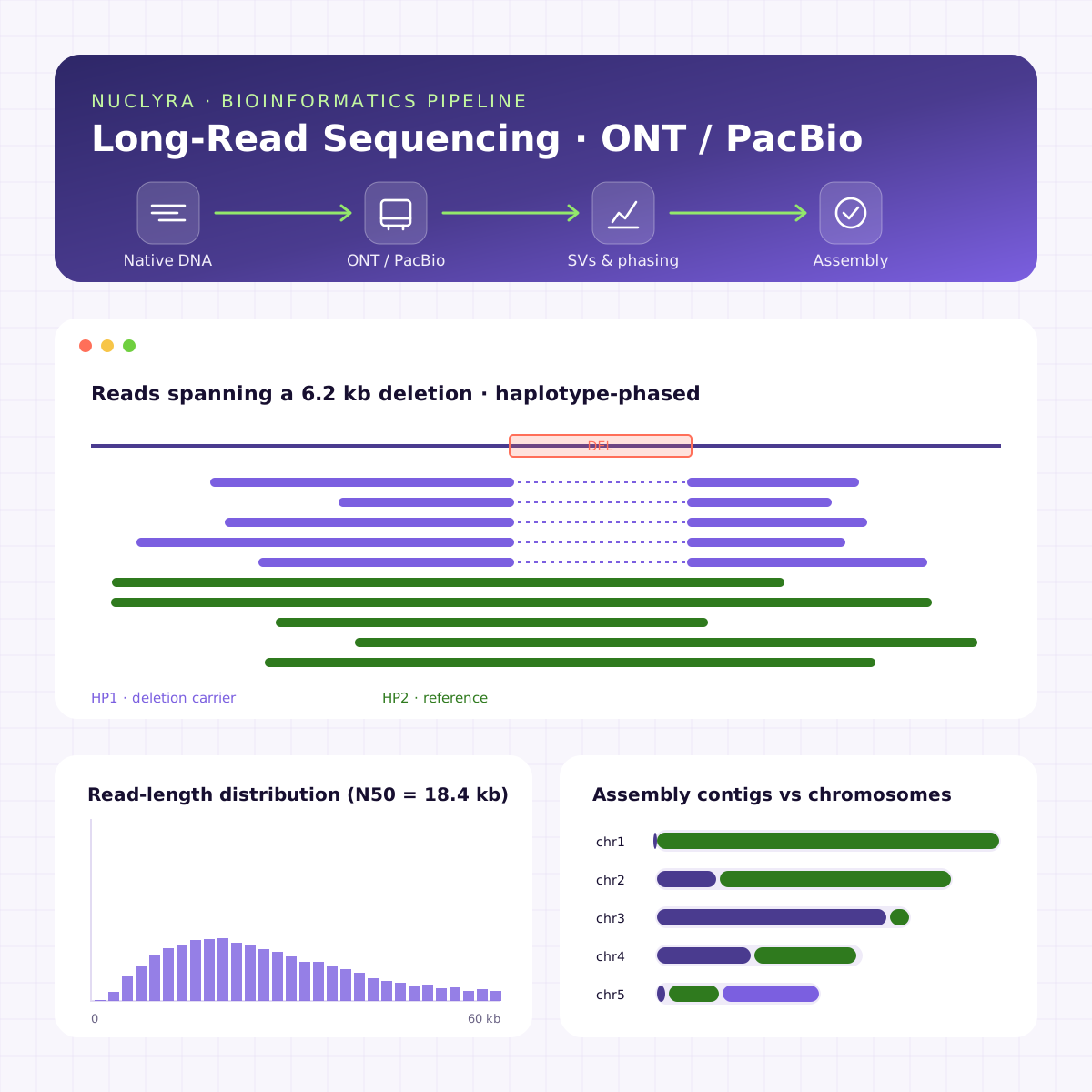
How an engagement runs
Four stages, from sample intake to delivery.
Basecall & QC
Raw signal or HiFi reads are basecalled, trimmed and quality-reported per run.
Align & call variants
Reads are aligned with long-read tools and small variants called on the platform’s error model.
SVs, phasing & assembly
Structural variants are called, haplotypes phased and assemblies built where required.
Annotate & hand off
Results are annotated, documented and delivered with reproducible configuration.
What we build it with
The variants that matter most are often the ones short reads were never long enough to see.
Before you reach out
Yes — Nanopore (simplex, duplex, cDNA and direct RNA) and PacBio HiFi and Iso-Seq data each get platform-specific basecalling, alignment and calling.
Yes. Starting from raw signal lets us rebasecall with current models and call base modifications such as 5mC directly.
Yes — hybrid approaches use short reads for polishing or small-variant accuracy and long reads for structure, phasing and assembly contiguity.
Explore related work
Whole Genome Sequencing
Short-read WGS for high-throughput small-variant calling across large cohorts.
View METHDNA Methylation (Bisulfite / EM-seq)
Conversion-based methylation profiling for high-depth CpG studies.
View BIOBioinformatics Pipeline overview
See how long-read sequencing fits into the full Bioinformatics Pipeline service.
ViewHave long-read data waiting on structural answers?
Send us your platform, chemistry and study goal — we’ll tell you honestly what your coverage and read lengths can resolve.