
ChIP Sequencing
ChIP-seq pipelines from raw reads to called peaks and annotated binding sites — built to separate real signal from background noise, with reproducibility checked, not assumed.
TYPICAL CLIENT
A regulatory biology lab mapping where a protein actually binds DNA
Usually a PI or computational biologist in an epigenomics or gene regulation lab studying transcription factor binding or histone modification, who needs peak calls they can defend — with input controls handled correctly and reproducibility checked across replicates.
Six concrete deliverables, not a slide deck.
This is exactly what transfers to you at the end of this ChIP Sequencing engagement.
Alignment & deduplication pipeline
Reads aligned and PCR duplicates removed, with input/control samples processed alongside ChIP samples.
Peak calling against matched input
MACS2-based peak calling that properly accounts for your input or IgG control, not just raw ChIP signal.
IDR reproducibility QC
Irreproducible discovery rate analysis across replicates, so reported peaks are ones that actually replicate.
Motif enrichment analysis
De novo and known motif enrichment within called peaks, to connect binding sites to sequence-level biology.
Peak annotation to nearest gene/TSS
Every peak annotated to its nearest gene and genomic feature, so results are interpretable without a second tool.
Full documentation & handoff session
Written documentation plus a recorded walkthrough so your team can operate the pipeline independently.
What this service includes
Alignment & deduplication
Reads aligned and PCR duplicates removed for both ChIP and input/control samples.
Input-normalized peak calling
MACS2-based calling that properly subtracts background using a matched input or IgG control.
IDR reproducibility analysis
Peaks scored for reproducibility across biological replicates before being called final.
Motif & gene annotation
Peaks annotated to nearest genes and screened for enriched sequence motifs.
What this looks like in a real engagement
Three concrete examples of the kind of work this service covers.
Transcription factor binding study
Genome-wide binding sites mapped for a transcription factor across multiple biological replicates.
Histone modification mapping
Broad-peak calling for histone marks like H3K27ac or H3K4me3 to define active regulatory regions.
CUT&RUN / CUT&Tag adaptation
The same peak-calling and QC framework adapted to the lower-background CUT&RUN and CUT&Tag protocols.
Why a peak call is only as trustworthy as its input control and its replicate.
ChIP-seq signal is noisy by nature — open chromatin and sequencing bias can produce peaks that look real but aren’t binding events at all. Without a properly matched input control and a reproducibility check across replicates, a peak list can be more artifact than biology.
We build ChIP-seq pipelines that treat the input control as a first-class part of the analysis and run IDR across replicates by default, so the peaks you report are ones that hold up.
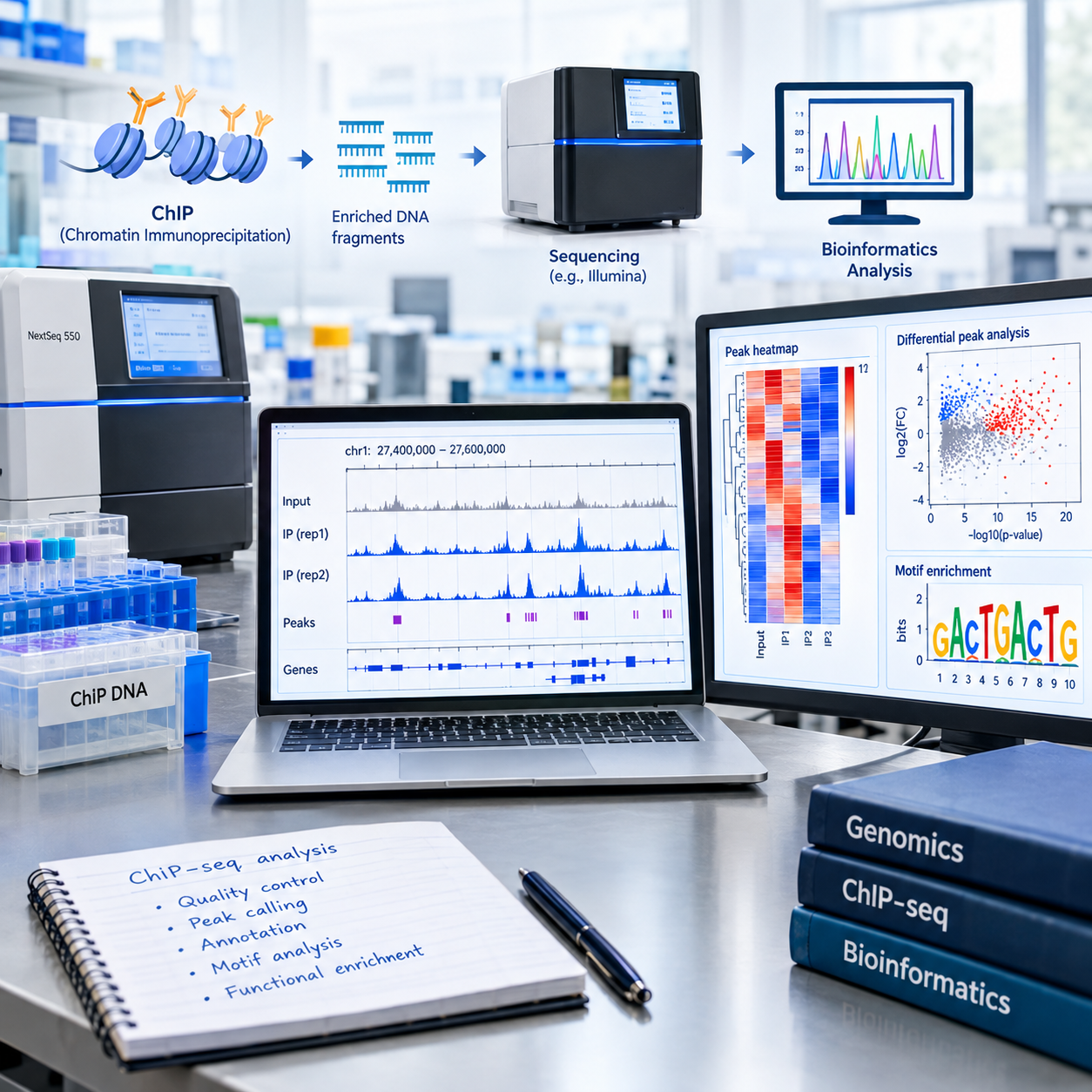
How an engagement runs
Four stages, from sample intake to delivery.
Alignment & dedup
ChIP and input samples are aligned and deduplicated under identical parameters.
Input-normalized peak calling
Peaks are called against the matched input control, narrow or broad depending on the mark.
IDR & replicate QC
Peaks are scored for reproducibility across replicates before being finalized.
Annotate & hand off
Final peaks are annotated to genes and motifs, then documented and delivered.
What we build it with
A peak without a matched input control is a hypothesis, not a result.
Before you reach out
Strongly recommended — input-normalized peak calling is substantially more reliable, and we can advise on control design before you sequence.
Broad-peak calling mode is used for diffuse histone marks, with parameters tuned separately from narrow transcription-factor peaks.
Yes — the same pipeline framework adapts to these lower-background protocols with adjusted peak-calling parameters.
Explore related work
Amplicon Sequencing
A targeted, primer-based approach for genotyping rather than protein-DNA binding.
View WGMShotgun Metagenomics
A different whole-community sequencing approach, applied to microbial ecosystems instead of chromatin.
View BIOBioinformatics Pipeline overview
See how ChIP sequencing fits into the full Bioinformatics Pipeline service.
ViewHave ChIP-seq data waiting on a defensible peak list?
Send us your protocol and control design — we’ll tell you honestly whether your controls support the peak calls you need.