

ATAC Sequencing
ATAC-seq pipelines that turn Tn5 insertion events into a defensible map of open chromatin — with fragment-level QC, differential accessibility and footprinting built in, not bolted on.
TYPICAL CLIENT
A gene regulation lab asking which regions of the genome open or close between conditions
Usually a PI or computational biologist in an epigenomics, immunology or developmental biology group comparing chromatin accessibility across cell types, treatments or time points, who needs accessibility calls that hold up across replicates and can be tied back to the transcription factors driving them.
Six concrete deliverables, not a slide deck.
This is exactly what transfers to you at the end of this ATAC Sequencing engagement.
Tn5-aware alignment & filtering
Reads aligned with Tn5 offset correction, mitochondrial reads and duplicates removed, and blacklist regions filtered out.
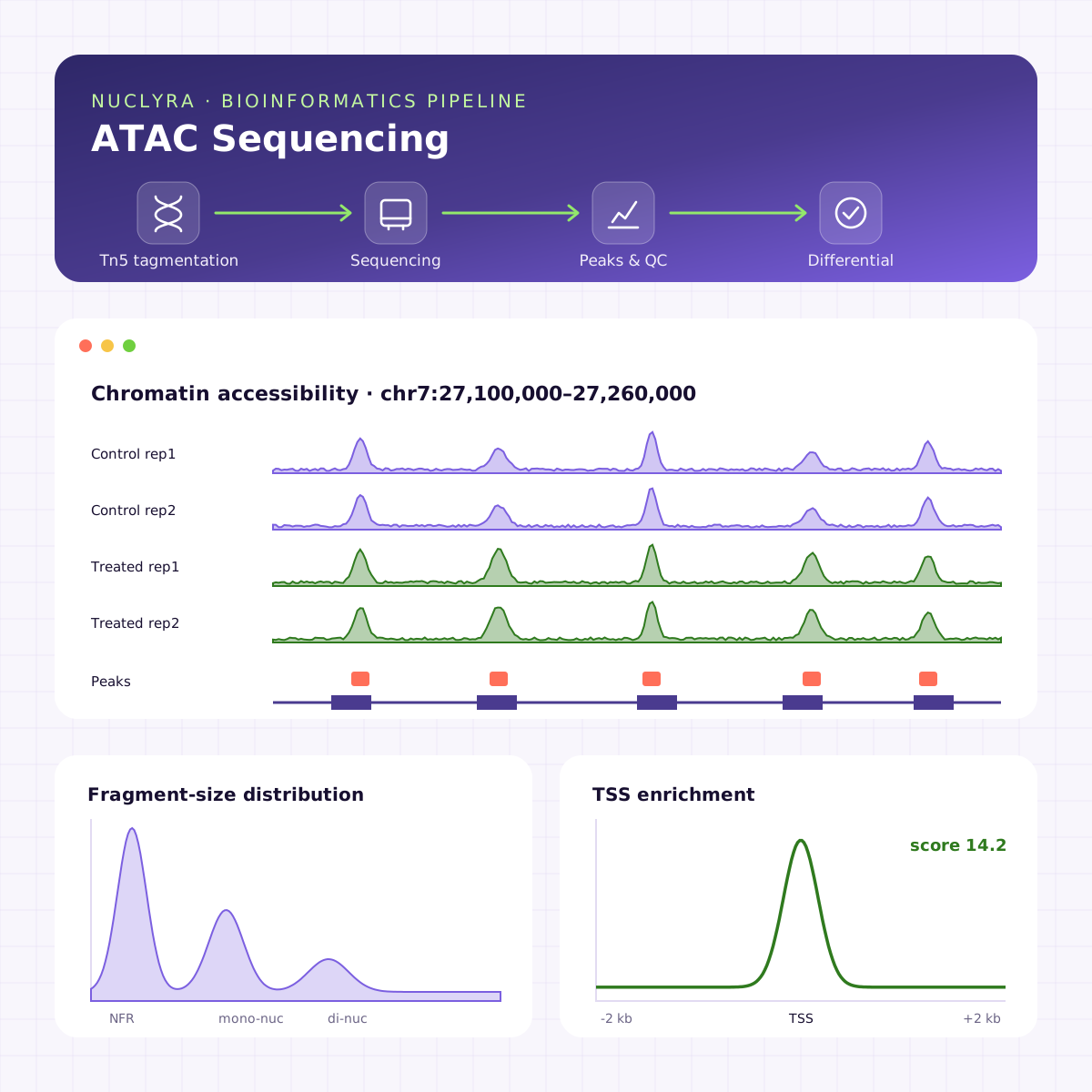
Fragment-size & TSS enrichment QC
Nucleosome-free vs mono-nucleosome fragment distributions and TSS enrichment scores reported per sample.
Reproducible accessibility peaks
MACS2-based peak calling with IDR or consensus filtering across replicates, merged into a single peak set.
Differential accessibility analysis
Count-based differential testing between conditions, with normalization chosen to fit your experimental design.
TF footprinting & motif activity
Transcription factor footprints and motif accessibility scores linking open regions to the regulators behind them.
Full documentation & handoff session
Written documentation plus a recorded walkthrough so your team can operate the pipeline independently.
What this service includes
Tn5-aware alignment
Insertion-site shifting, mitochondrial read removal and blacklist filtering before anything is called.
Accessibility peak calling
Replicate-aware peak calling merged into a consensus set ready for quantification.
Fragment & TSS QC
Nucleosome periodicity, FRiP and TSS enrichment checked for every library.
Differential & footprint analysis
Condition-level accessibility changes plus TF footprinting and motif activity.
What this looks like in a real engagement
Three concrete examples of the kind of work this service covers.
Cell-state comparison
Accessibility landscapes compared between treated and untreated cells to find regulatory regions that open on stimulation.
Integration with RNA-seq
Differentially accessible regions linked to nearby differentially expressed genes for a combined regulatory view.
Single-cell ATAC adaptation
The same QC philosophy applied to scATAC-seq — per-cell fragment QC, clustering and peak-to-gene linkage.
Why accessibility calls depend on fragment-level QC, not just read counts.
ATAC-seq libraries can look fine by read count and still be poor — high mitochondrial fraction, weak nucleosome periodicity or low TSS enrichment all mean signal is being diluted by background. Peaks called on a bad library are rarely flagged as bad.
We build ATAC-seq pipelines that score every library on fragment structure and TSS enrichment before peaks are called, so differential accessibility is computed only on data that earns it.
How an engagement runs
Four stages, from sample intake to delivery.
Align & filter
Reads are aligned, Tn5-shifted and stripped of mitochondrial, duplicate and blacklisted reads.
Fragment & TSS QC
Fragment distributions, FRiP and TSS enrichment are scored per library before calling.
Peaks & differential accessibility
Consensus peaks are called and tested for accessibility changes between conditions.
Footprint & hand off
Regions are annotated, footprinted for TF activity, documented and delivered.
What we build it with
An open-chromatin peak is only as good as the library it was called from.
Before you reach out
At least two per condition, ideally three. With fewer, we can still call peaks, but differential results will be reported as exploratory.
Often yes. Mitochondrial reads are filtered out and we report how much usable depth remains, so you can decide whether to resequence before analysis.
Yes — scATAC and 10x Multiome data are handled with per-cell fragment QC, clustering and peak-to-gene linkage alongside the bulk framework.
Explore related work
ChIP Sequencing
Protein-specific binding maps that complement genome-wide accessibility.
View SCSingle-Cell RNA Sequencing
Pair accessibility with expression at single-cell resolution.
View BIOBioinformatics Pipeline overview
See how ATAC sequencing fits into the full Bioinformatics Pipeline service.
ViewHave ATAC-seq libraries waiting on an accessibility map?
Send us your library QC and experimental design — we’ll tell you honestly whether the data supports the comparisons you want to make.