
Healthcare & Diagnostics
Secure, validated systems for patient-facing data, diagnostic pipelines and clinical decision support.

TYPICAL CLIENT
A CTO or Chief Medical Officer at a diagnostics company with a patient-facing pipeline or decision-support tool
Responsible for a system whose output directly informs a clinical decision, operating under HIPAA and often preparing for or responding to a compliance audit.
The problems that bring teams to us.
A model nobody can fully explain
Predictive tools that work but can’t produce a clinician-readable rationale create both clinical and regulatory risk.
Patient data access control that wasn’t designed in from the start
Retrofitting HIPAA-aware access control onto an existing system is slower and riskier than building it in from the architecture stage.
Failed or looming compliance audits
A failed audit finding needs both a technical fix and documentation an auditor will actually accept on re-review.
Four places we plug into your program.
What each of these actually looks like day to day — not just the one-line version.
Diagnostic pipeline validation
Diagnostic pipelines carry a different bar than a research pipeline — the output needs to hold up to a lab director’s sign-off and, in many cases, a regulator’s review. We build and validate analysis pipelines against that standard from the outset, with test suites, accuracy benchmarks and documentation that a validation reviewer can follow end to end.
- Analytical validation against reference standards and known-positive/negative panels
- Version-controlled pipelines with locked, auditable release history
- Validation documentation packaged alongside the pipeline, not written after the fact

HIPAA-aware architecture
Retrofitting patient-data protections onto a system that wasn’t designed for them is slower and riskier than building it in from the schema up. We design access control, encryption and audit logging into the architecture itself, so HIPAA alignment is a property of the system rather than a checklist run against it later.
- Role-based access control scoped to the minimum data a role actually needs
- Encryption at rest and in transit by default across every environment
- Immutable audit logging covering every read and write to patient data

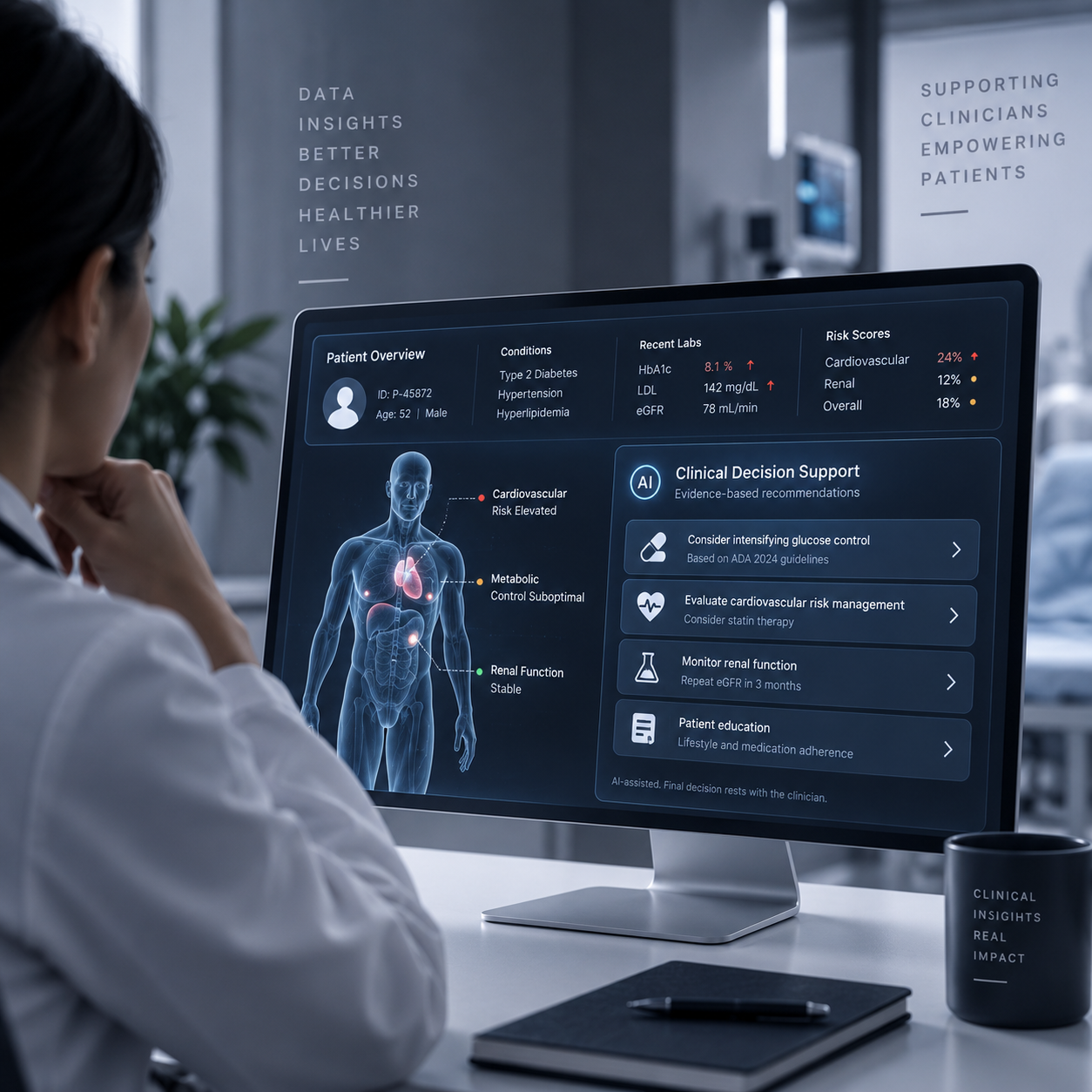
Clinical decision support
A predictive model that clinicians don’t trust doesn’t get used, no matter how accurate it is. We build decision-support tools designed to inform a clinician’s judgment rather than replace it, with explainability built into the model output so a recommendation can be reasoned through, not just accepted on faith.
- Models that surface the clinical features driving each recommendation
- Calibration and drift monitoring to catch performance decay after deployment
- Output framed as decision support, never as an autonomous diagnosis
EHR & lab system integration
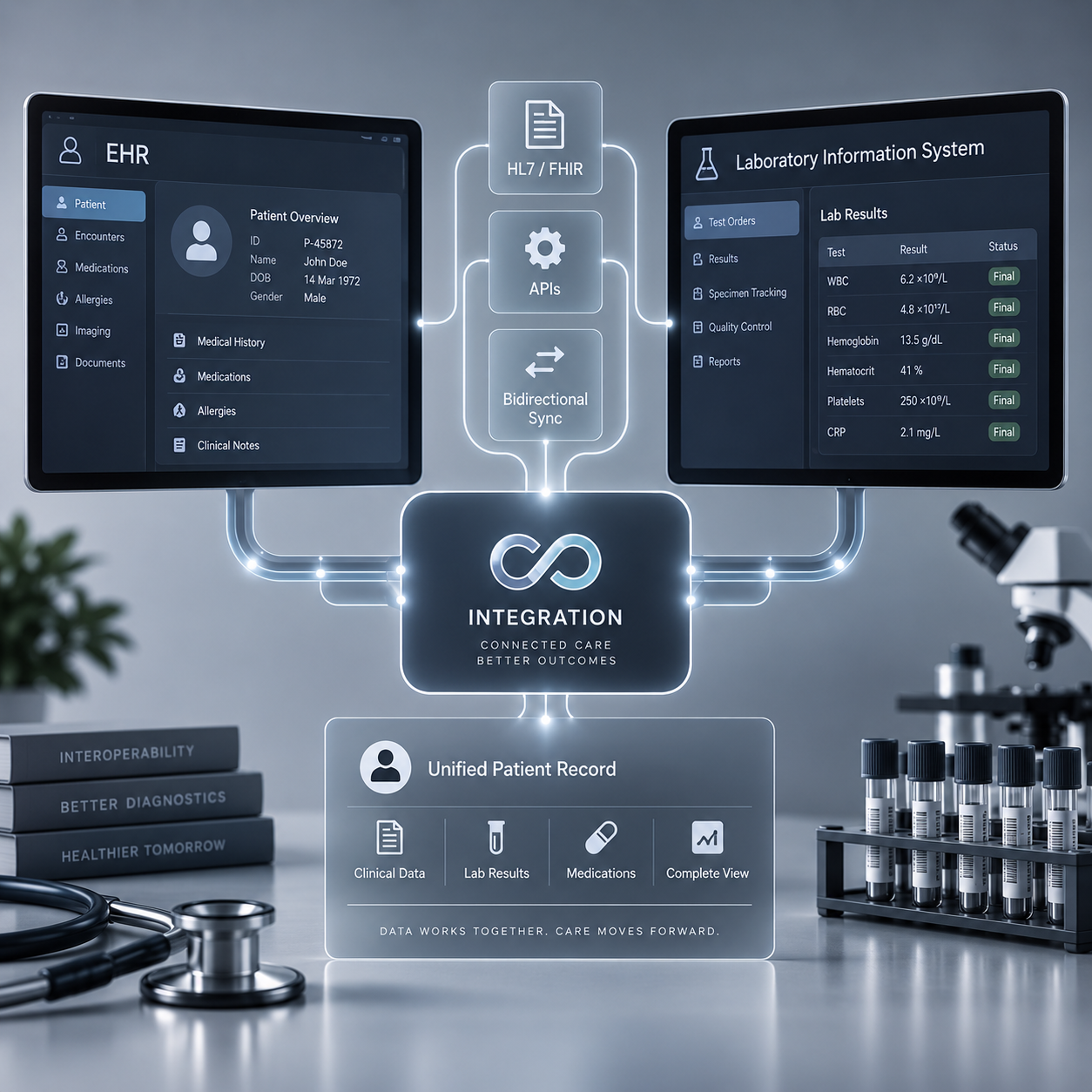
A diagnostic pipeline that produces a great result nobody sees isn’t useful. We build integration layers that connect analysis pipelines to the EHR and lab information systems clinicians already work in, so results land where a care decision actually gets made instead of in a separate portal.
- HL7/FHIR-based integration with existing EHR platforms
- Bi-directional sync with laboratory information management systems (LIMS)
- Integration built around your existing vendor stack, not a forced migration
When the output is a result a patient’s care depends on.
Diagnostic and clinical systems carry a different bar than a research pipeline — validation, auditability and explainability aren’t optional extras, they’re the product. We design for that bar from the first architecture decision.
That includes access control that respects patient consent, and models that can explain a recommendation in terms a clinician can act on.
How we approach this field
Four stages, shaped around how this industry actually operates.
Establish the validation bar
We define the accuracy, auditability and explainability standard the system must meet before design begins.
Design for patient data
HIPAA-aware access control and encryption are built into the architecture, not bolted on.
Build & integrate
Pipelines and decision-support tools are built and integrated with existing EHR and lab systems.
Validate & monitor in production
Ongoing validation and drift monitoring keep clinical systems trustworthy after launch.
They understood that a false negative isn’t a metrics problem for us — it’s a patient outcome.
Before you reach out
Yes, this is one of our most common healthcare engagements: remediating findings and producing documentation built for the specific auditor’s requirements.
No, we design decision-support tools to inform, not replace, a clinician’s judgment, with explainability built in for exactly that reason.
Yes, we integrate with existing EHR and lab information systems as they are, rather than requiring a vendor change.
Explore related work
Building a system that touches patient data?
Tell us what data it touches and who relies on the result — we’ll scope the right validation bar.