
Government & Public Health
Population-scale genomic surveillance, outbreak analytics and public-health data infrastructure.

TYPICAL CLIENT
A genomic surveillance or public health informatics lead at a government health agency
Responsible for pathogen genomic surveillance or outbreak response infrastructure that needs to perform reliably under sudden, unpredictable load.
The problems that bring teams to us.
Infrastructure that can’t handle a sudden volume spike
Sequencing volume during an outbreak can jump 10x overnight, and infrastructure built for steady-state volume buckles under that load.
Data siloed across jurisdictions
Multiple public health jurisdictions often can’t easily share surveillance data without compromising each one’s governance requirements.
Turning sequencing data into a decision in days, not weeks
Raw sequencing data is only useful to public health teams once it’s translated into an actionable report, quickly.
Four places we plug into your program.
What each of these actually looks like day to day — not just the one-line version.
Genomic surveillance platforms
Catching an emerging variant early means processing sequencing data fast enough to act on it, not just archive it. We build genomic surveillance infrastructure that flags variants of concern at population scale, so public health teams see a signal while there’s still time to respond to it.
- Automated variant-calling and lineage classification at population scale
- Alerting tuned to flag emerging variants of concern, not just novel ones
- Infrastructure that scales from routine surveillance to outbreak-level volume

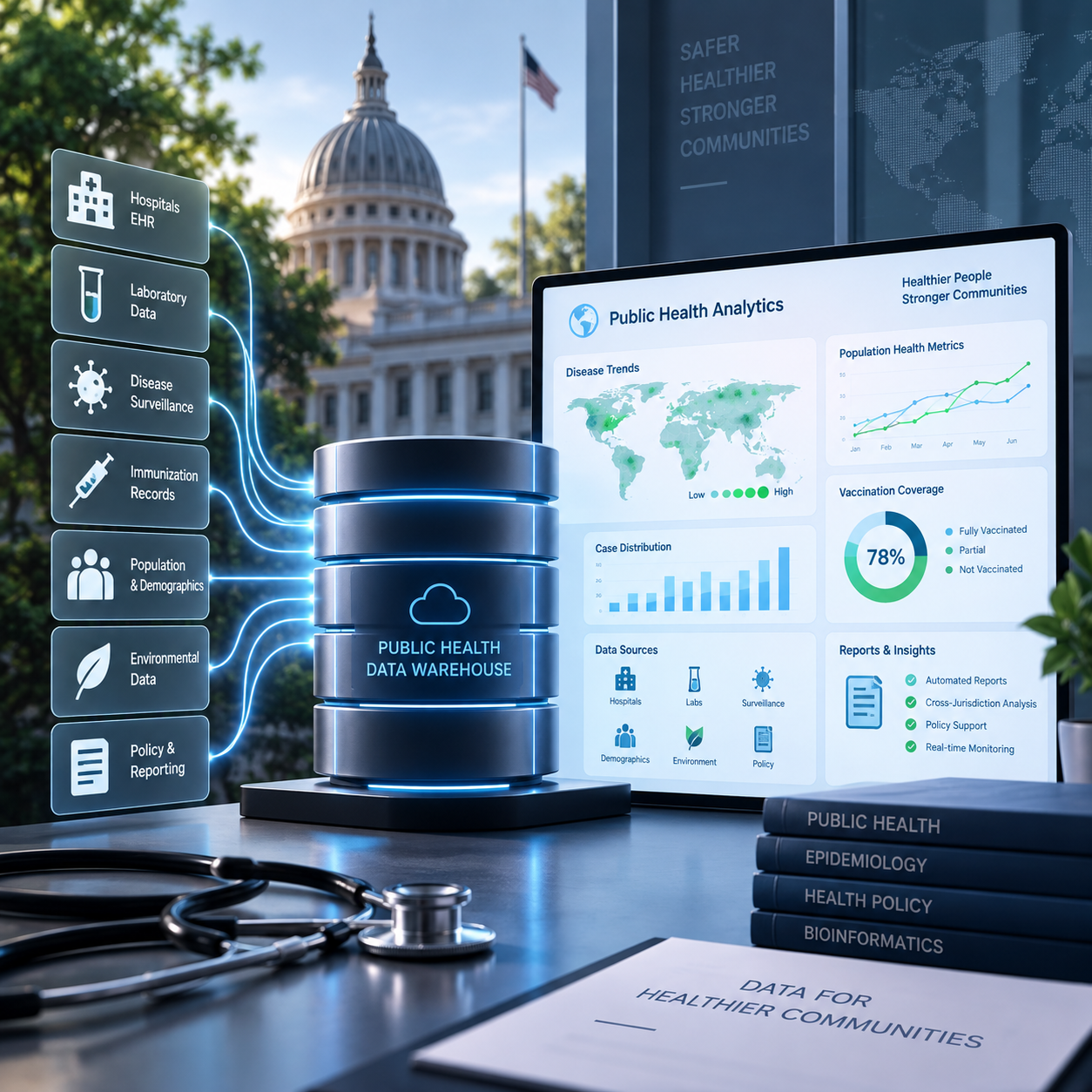
Public health data warehousing
Public health data usually lives across multiple jurisdictions with different formats, consent rules and access policies, which makes cross-jurisdiction analysis slow exactly when speed matters most. We build harmonized, privacy-preserving data warehouses that let jurisdictions share what’s needed for analysis without giving up control of the underlying records.
- Harmonized data model spanning multiple jurisdictions and data sources
- Privacy-preserving access controls aligned to each jurisdiction’s policy
- Reporting layers built for public health analysts, not just data teams
Outbreak analytics
During an active outbreak, the gap between raw sequencing data and an actionable answer is where response time gets lost. We build rapid analysis pipelines that turn incoming sequencing and case data into outbreak intelligence a response team can act on within hours, not weeks.
- Rapid pipelines from raw sequencing data to transmission-chain analysis
- Dashboards built for outbreak response teams under time pressure
- Infrastructure pre-built and tested before an outbreak, not during one

Privacy-preserving architecture
Population-level public health data carries a different privacy bar than a single clinical system, since the risk of re-identification compounds as datasets get linked. We design de-identification and access control specifically for that risk, so data stays useful for analysis without exposing individuals.
- De-identification pipelines tuned to population-level re-identification risk
- Access control aligned to public health data-sharing agreements
- Architecture reviewed against relevant public-sector security standards

Infrastructure built for the pace an outbreak actually moves at.
Public health genomic infrastructure is judged in a crisis, not a demo. We build surveillance and analytics pipelines that are stress-tested to perform when sequencing volume spikes without warning.
That means pipelines that scale elastically, and data architecture that stays privacy-preserving even as more jurisdictions are added under pressure.
How we approach this field
Four stages, shaped around how this industry actually operates.
Assess current capacity
We evaluate your existing surveillance infrastructure against realistic outbreak-scale sequencing volumes.
Build elastic pipelines
Sequencing and analysis pipelines are built to scale automatically as volume spikes.
Harmonize across jurisdictions
Data from multiple jurisdictions is unified without compromising each one’s governance requirements.
Deliver real-time analytics
Dashboards surface emerging patterns to public health teams as data arrives, not after the fact.
When our sequencing volume tripled overnight, the platform didn’t even need a conversation — it just scaled.
Before you reach out
Yes, our pipelines are designed to scale elastically with sequencing volume rather than requiring a manual capacity request.
Yes, we’ve built platforms that harmonize data across jurisdictions while respecting each one’s individual governance requirements.
We’re familiar with standard government procurement and contracting processes and can work within your agency’s requirements.
Planning for the next surge in sequencing volume?
Tell us your current infrastructure and jurisdiction count — we’ll assess where the bottlenecks will show up first.